- Home
- Government
- Departments
- Planning
- Conservation and Climate Adaptation
- Residential Composting
Residential Composting
Composting is the managed, aerobic (oxygen-required) biological decomposition of organic materials by microorganisms. Organic (carbon-based) materials include grass clippings, leaves, yard and tree trimmings, and food scraps. The end product is compost, a biologically stable soil amendment that can be used to build soil health and provide nutrients to plants. Microorganisms feed on the materials added to the compost pile during the composting process. They use carbon and nitrogen to grow and reproduce, water to digest materials, and oxygen to breathe. You can compost at home using food scraps from your kitchen and dry leaves and woody material from your yard.
A 2015 study by the Rhode Island Resource Recovery Corporation found that 89,926 tons of organic waste that could be composted is disposed of in Rhode Island’s landfill each year. This accounts for approximately 32% of the total municipal solid waste. It is projected that the Johnston landfill will exhaust its permitted disposal capacity by the year 2046. Composting is a great way to reduce some of the food and yard waste from landfills and turn it into a useful product to feed our gardens!
LEAF & YARD COMPOSTING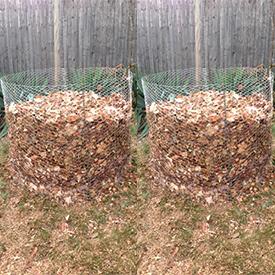
Leaf & Yard waste includes fresh grass clippings, leaves, twigs, dead plants and flowers, untreated wood chips, and straw. Add used coffee grounds for a boost of nitrogen! You can compost leaves as-is but shredding them, with a lawn mower or use a leaf blower’s vacuum and bag attachment, is very helpful as it results in faster decomposition.
Option 1: Mulch in place or add to beds: You can mulch leaf and yard debris right onto your soil using the mulching attachment on your lawn mower, or simply by removing the collection bag. Grass clippings and shredded leaves will remain on your lawn, where air and rain will return them to your soil. If you have garden beds, you can place mulched leaves on them in the fall, in preparation for spring planting.
Option 2: Make a pile or build/buy bins: You can rake leaves (or better yet, shredded leaves) into a pile in the corner of your yard—no bin required! It you want to keep things tidy, you can buy a bin at Resource Recovery or make a simple leaf bin using galvanized chicken wire, tin snips, and four metal stakes. Ten feet of chicken wire will make a bin that holds 16 bags of leaves after they've been shredded!
Maintaining your pile
Your pile needs oxygen, use a garden tool, like a hoe or a pitchfork, to stir up contents weekly. Your pile should feel like a wrung-out sponge. If it is dry, add a little water.
FOOD SCRAP COMPOSTING
According to the EPA, over 20% of municipal trash is food waste – that’s over 38 million tons in the U.S. each year. Composting food waste is a natural process that transforms kitchen scraps into nutrient-rich soil amendment. It not only diverts organic waste from landfills but also reduces greenhouse gas emissions and recovers valuable nutrients that would otherwise be lost.
Search online for “DIY compost bins” if you want to build your own or buy bins at Resource Recovery.
What goes in my bin?
For best results, follow the 1:3 Rule. For every 1 part of green material that you add to your compost, top with 3 parts of brown material.
“Green Material” = Vegetable and fruit peels, cores, rinds and scraps, spoiled vegetables and fruits, eggshells, coffee grounds, filters, and tea bags, grass clippings, and fresh plant and yard trimmings.
“Brown Material” = Leaves, twigs, dead flowers, straw, corn stalks and husks, shredded cardboard and paper, paper towels and napkins, vacuum cleaner bag contents, dryer lint, untreated wood chips, and sawdust.
Do NOT compost – meat, fish, and poultry, bones, dairy products, egg whites and yolks, fats, oil, and grease, pet waste, weeds laden with seeds, and diseased plants.
Using Your Bin
For daily collection, use an airtight scrap pail on your counter or keep a scrap container or bag in the fridge or freezer. Chop up larger scraps into smaller pieces.
When adding to your outside bin, remember to keep a 3:1 ratio of browns to greens. Your pile should feel like a wrung-out sponge. If it is dry, add a little water. If it is wet, add some browns. Your pile needs oxygen - use a garden tool, like a hoe or a pitchfork, to stir up contents weekly.
Harvesting compost
One bin method: Use a screen built with 2x4s and wire mesh to separate recognizable debris from compost. Use the separated compost and return debris back into bin.
Two bin method: Stop adding materials to bin #1 and start adding bin #2. Continue to stir up contents of bin #1 until all debris breaks down. When you’ve used all the compost of bin #1, switch bins and begin adding to bin #1 while stirring up and eventually harvesting from bin #2.
Using Compost
Compost with no recognizable debris needs to be cured by sitting for about four weeks before it is at ambient temperature, and ready to use. One way to ensure compost is cured is to apply it four weeks before planting.
New beds: Till 1-3” of compost into the top 12” of dark soil or 2-6” into light soil.
Maintenance: Once fully cured, place on areas that you have already planted.
Basic potting mix = 1/3 compost +1/3 sand + 1/3 soil
BUY A COMPOST BIN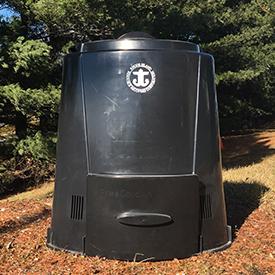
Bins are available for purchase from the Resource Recovery: Buy a Compost Bin.
There are two types of residential composting that can be beneficial: Leaf & Yard composting and Food Scrap Composting.
NEED MORE COMPOST?
Compost made from RI's leaf and yard debris, and approved for use in organic growing, is available at Resource Recovery.